Overview
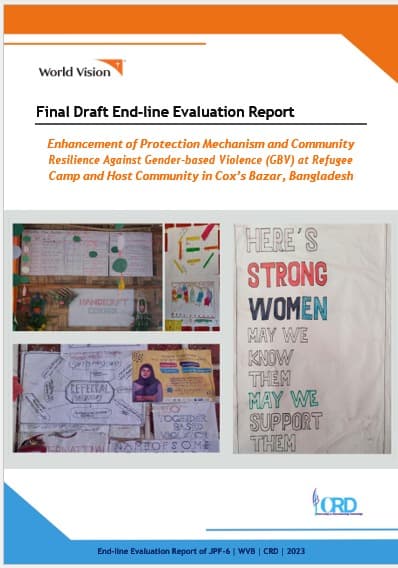
RMCL conducted the end-line evaluation of the project titled “Enhancement of Protection Mechanism and Community Resilience Against Gender-Based Violence (GBV) at Refugee Camp and Host Community in Cox’s Bazar, Bangladesh” implemented by World Vision Bangladesh with support from World Vision Japan. The assignment was implemented within the Rohingya refugee response context in Cox’s Bazar, recognized as one of the world’s largest refugee crises and humanitarian settlements. The evaluation assessed the effectiveness, outcomes, and sustainability of GBV prevention and response interventions designed to strengthen protection systems, survivor support mechanisms, and community resilience among Forcibly Displaced Myanmar Nationals (FDMNs) and host communities. The study generated critical evidence on community-based protection approaches within highly vulnerable humanitarian settings affected by displacement, gender inequality, and social vulnerabilities.
RMCL provided comprehensive technical and operational leadership for the assignment, including:
- 1End-line evaluation design and methodological framework development;
- 2Quantitative and qualitative data collection in refugee camps and host communities;
- 3GBV-related protection and resilience assessments;
- 4Community consultations and stakeholder engagement;
- 5Data analysis, interpretation, and reporting;
- 6Strategic recommendations for humanitarian programming and sustainability
The evaluation examined key thematic areas including:
- 1Gender-Based Violence (GBV) prevention and response systems;
- 2Community awareness and protection mechanisms;
- 3Survivor-centered support services and referral pathways;
- 4Women and adolescent girls’ safety and participation;
- 5Psychosocial support and community resilience;
- 6Access to protection and humanitarian services;
- 7Capacity strengthening of local protection structures
Evidence-Based Programming & Resilience Building
Using ethical, survivor-sensitive, and humanitarian research approaches, RMCL conducted field implementation within complex refugee settings while maintaining strict safeguarding, confidentiality, and Do No Harm principles. The assignment incorporated gender-responsive methodologies and participatory approaches to capture the perspectives of women, adolescent girls, community members, service providers, and humanitarian stakeholders. The findings contributed to strengthening evidence-based humanitarian programming and protection-focused interventions within refugee and host community settings in Bangladesh. The evaluation provided actionable recommendations to improve GBV prevention systems, survivor support mechanisms, community engagement strategies, and resilience-building interventions in humanitarian contexts. This assignment demonstrates RMCL’s expertise in humanitarian research, refugee response evaluations, gender-based violence assessments, protection programming, and complex field operations within emergency and displacement settings. RMCL continues to support development and humanitarian partners through evidence-driven approaches that strengthen protection, inclusion, and resilience among vulnerable populations.
Published by RMCL — Research & Management Consultants Ltd.