
Overview
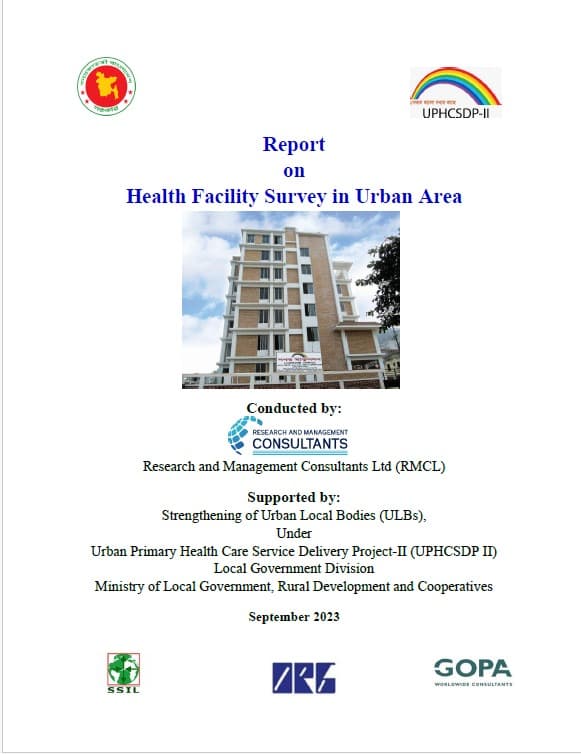
RMCL conducted one of the largest urban health facility assessment studies in Bangladesh under the Urban Primary Health Care Service Delivery Project-II (UPHCSDP-II), implemented by the Local Government Division under the Ministry of Local Government, Rural Development and Cooperatives. The assignment was supported through the Strengthening of Urban Local Bodies (ULBs) initiative in collaboration with GOPA Worldwide Consultants. The nationwide study aimed to generate comprehensive evidence on the status, distribution, functionality, service readiness, and operational capacity of health facilities across urban areas of Bangladesh. The assessment covered public, private, NGO, and community-based health facilities operating within city corporations and municipalities, providing critical insights into urban healthcare infrastructure and service delivery systems.
RMCL provided technical and operational leadership for the assignment, including:
- Survey design and methodological framework development;
- Development of digital data collection systems and tools;
- Large-scale field implementation and supervision;
- GIS-supported facility mapping and verification;
- Health facility infrastructure and service readiness assessment;
- Data management, quality assurance, and analytics;
- Evidence generation for urban health planning and policy support.
The study assessed multiple dimensions of urban healthcare systems, including:
- 1Availability of primary healthcare services;
- 2Maternal, neonatal, and child health services;
- 3Human resources for health;
- 4Facility infrastructure and equipment;
- 5Essential medicines and diagnostic capacity;
- 6Referral systems and service accessibility;
- 7Water, sanitation, hygiene, and waste management systems;
- 8Digital reporting and health information systems.
Conclusion
Using technology-enabled field operations and electronic data collection platforms, RMCL deployed trained supervisors, researchers, and enumerators across multiple urban locations to ensure high-quality, real-time data collection and monitoring. The assignment integrated GPS-enabled verification, centralized monitoring systems, and data quality control mechanisms to strengthen accuracy and operational efficiency. The findings of the assessment contributed to evidence-based urban health planning, institutional strengthening, and decision-making processes under the UPHCSDP-II and broader urban health sector reforms in Bangladesh. The study provided actionable recommendations to improve service coverage, infrastructure planning, health system governance, and equitable access to quality healthcare services for urban populations. This assignment demonstrates RMCL’s expertise in conducting large-scale health systems research, urban health assessments, digital data management, and complex field operations, supporting governments and development partners in strengthening evidence-informed health sector programming and policy development.
Published by RMCL — Research & Management Consultants Ltd.